The Simple Math Behind 81 Pairs
 The Simple Math Behind 81 Pairs
9 numbers × 9 colors = 81 unique combinations. Each number-color pair exists exactly once in a completed Suirodoku grid. There is only one "Red 5", only one "Blue 3", only one "Green 7"...
Like a deck of cards: Just as a deck has 52 unique cards (13 ranks × 4 suits), Suirodoku has 81 unique cells (9 numbers × 9 colors). Every single one is different.
What Does This Actually Mean?
 What Does This Actually Mean?
In classic Sudoku, the number 5 appears 9 times in the grid (once per row). In Suirodoku, the number 5 also appears 9 times — but each one has a different color:
- Red 5, Blue 5, Green 5, Yellow 5...
- Each is unique and appears only once
- No two cells in the entire grid are identical
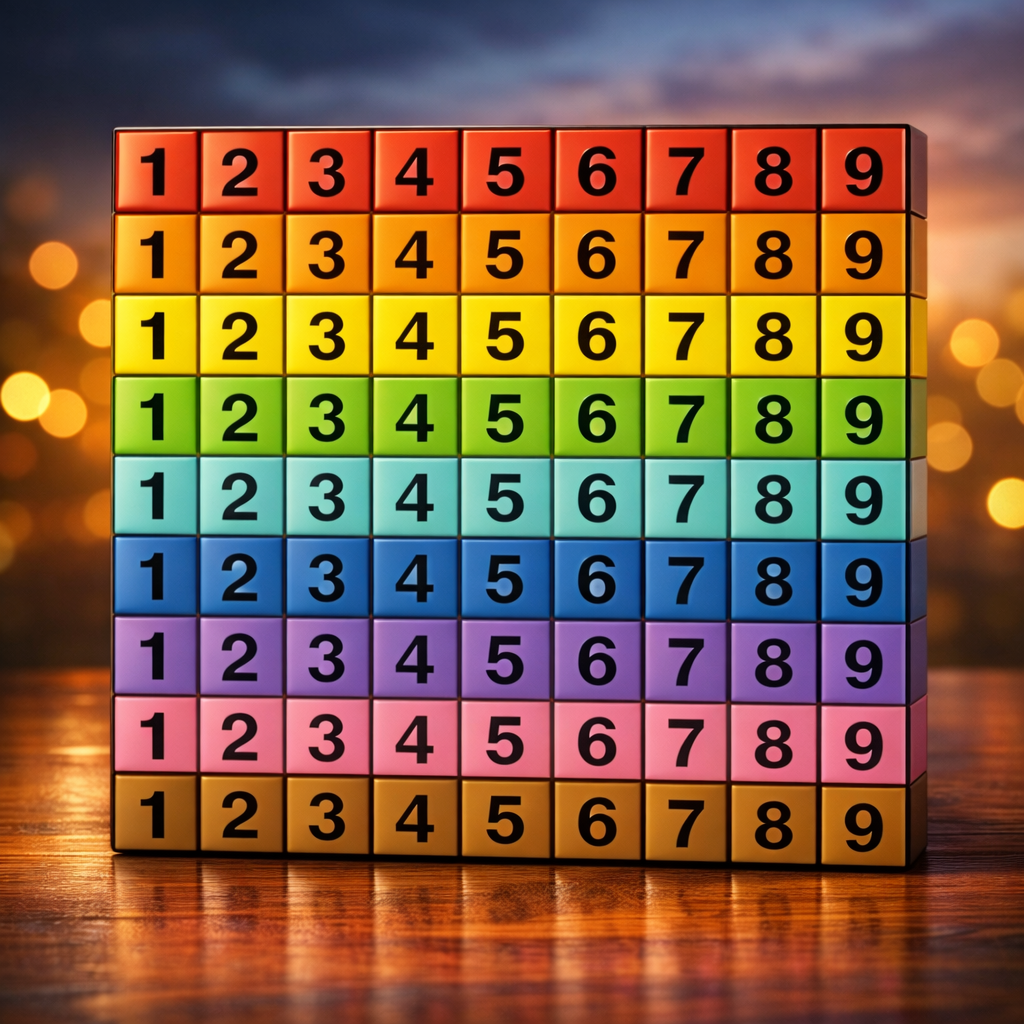
In Sudoku, "5" is just "5" — it repeats 9 times identically. In Suirodoku, there are nine different versions of 5, each with its own color. That's the fundamental shift.
The Numbers That Matter
 The Numbers That Matter


That's not a coincidence. 81 cells and 81 unique pairs means every cell gets its own combination. Nothing repeats, ever. This is what makes Suirodoku a true Graeco-Latin square.
Sudoku vs Suirodoku — Side by Side
 Sudoku vs Suirodoku — Side by Side
| Aspect | Sudoku | Suirodoku |
|---|---|---|
| Cell content | Number only | Number + Color |
| Unique elements | 9 (numbers 1-9) | 81 (all pairs) |
| Duplicates | Each number appears 9× | No duplicates — ever |
Why Does This Matter for Solving?
 Why Does This Matter for Solving?
The 81 unique pairs aren't just a math curiosity — they unlock two solving techniques that simply don't exist in classic Sudoku:
- Rainbow Technique: Track a single number across all 9 colors to find where the missing one must go.
- Chromatic Circle: Track a single color across all 9 numbers to eliminate possibilities.

These techniques only work because each pair is unique. If "Red 5" existed twice, you couldn't deduce anything from tracking it!
Uniqueness creates deductive power. The more constraints you have, the more information you can extract from each clue. That's what makes Suirodoku deeper than classic Sudoku.
How to Use 81 Unique Pairs While Solving
Ready to put this into practice? Follow these three steps:
- Identify the pair you need: When you place a number, ask "which color?" — or when you place a color, ask "which number?"
- Scan for eliminations: If 7-Blue already exists somewhere, no other cell can be 7-Blue. Use this to narrow down possibilities.
- Apply Rainbow or Chromatic Circle: Track all 9 instances of a number (Rainbow) or a color (Chromatic Circle) to find the missing one.
The Sudoku with a 4th Constraint


Conclusion
The 81 unique pairs rule is the single most important concept in Suirodoku. It's what separates this puzzle from classic Sudoku — and it's what gives you powerful new ways to solve. Once you internalize that every cell has its own identity, you'll start seeing deductions that were invisible before.