A Quick Warm-Up — The 4×4 Case
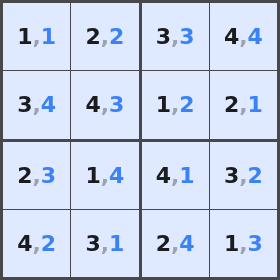
Before tackling the 9×9 grid, let's start small. A 4×4 Suirodoku works just like its big sibling: each cell carries a digit (1–4) and a color, with 2×2 blocks instead of 3×3. All 16 digit-color pairs must be unique.
Using the CP-SAT model from Part 1, exhaustive enumeration takes 0.23 seconds and yields a clean result: there are exactly 2,304 Suirodoku grids of order 4. For comparison, there are 288 Sudoku 4×4.

The ratio 2,304 / 288 = 8: on average, each 4×4 Sudoku admits exactly 8 valid color mates. Clean, symmetric, predictable. At order 9, the landscape is incomparably more vast — and far less uniform.
What Is a Mate?
 What Is a Mate?
A Suirodoku is the superposition of two Sudoku grids. The first layer contains digits; the second contains colors. Both must be valid Sudoku independently, and when you overlay them, every digit-color pair must appear exactly once.
Given a base (the digit layer), a mate is a color layer that completes it into a valid Suirodoku. The mate must satisfy three conditions: it must be a valid Sudoku, it must be orthogonal to the base (all 81 pairs unique), and both conditions at once.
Not every Sudoku has a mate. A Sudoku grid must have specific mathematical properties — enough transversals — to admit even one orthogonal partner. Most don't.
The central question is: for a given base, how many mates exist? The answer depends entirely on the algebraic structure of the base. Some bases have zero. Others have billions.
The Back-Circulant — The Most Symmetric Sudoku
 The Back-Circulant — The Most Symmetric Sudoku
Among all 5,472,730,538 essentially different Sudoku grids, one stands out: the back-circulant. It has 648 symmetries — the maximum. You can permute its rows, columns, and blocks in 648 different ways and always land back on the same grid (after relabeling).
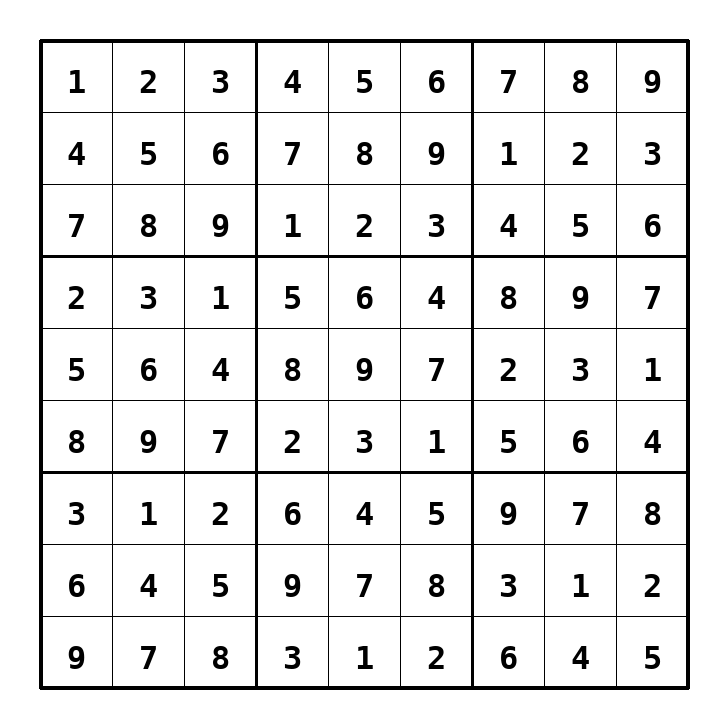
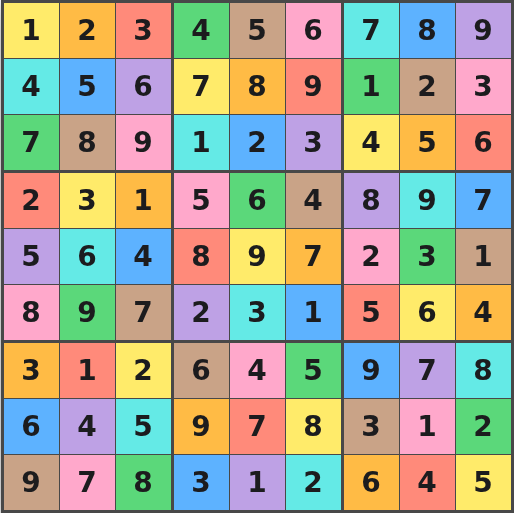
Its formula is simple: digit[r][c] = (3(r mod 3) + ⌊r/3⌋ + c) mod 9 + 1. Notice the diagonal pattern within each band — each row shifts by 1, each band shifts by 3. This regularity is what gives it maximum symmetry.
The back-circulant is an isotope of the cyclic group Z₉. In plain terms: its algebraic structure is as regular as possible. This makes it the ideal starting point for enumeration — if any Sudoku has many mates, it's this one.
From 9 Known to 3.62 Billion
Before this work, Subramani (2012) had constructed 9 mates for the back-circulant using an algebraic method. Nine. That was the state of the art.
Using the CP-SAT model from Part 1 with symmetry breaking (fixing the first color to eliminate 9 equivalent copies), we ran an exhaustive enumeration. The result:
| Measure | Value |
|---|---|
| Mates with symmetry breaking (k[0][0] = 0) | 402,479,717 |
| Total mates (× 9) | 3,622,317,453 |
| Previously known | 9 |
| Improvement factor | 402,479,717× |
That's 3.62 billion valid mates — each one producing a distinct, complete Suirodoku grid when paired with the back-circulant. An exact count, not an estimate.
The back-circulant admits exactly 3,622,317,453 orthogonal Sudoku mates. This is an exhaustive, computer-verified count.
Among these 3.62 billion grids, one stands above all others: the Crystal Grid — the unique Suirodoku with maximal symmetry (1,296 automorphisms). We'll explore it in detail in Part 4.
The 99.92% Filter
 The 99.92% Filter
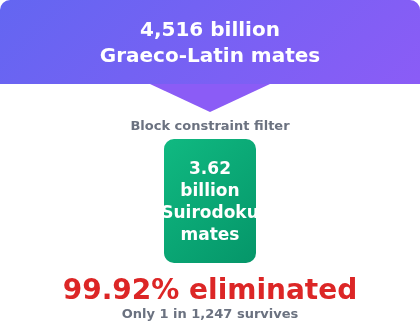
Here's the remarkable part. The back-circulant, viewed as a plain Latin square (ignoring blocks), admits 4,516 billion Graeco-Latin mates (Egan & Wanless, 2016). That's the number of second layers that are orthogonal — where all 81 pairs are unique.
But a Suirodoku isn't just a Graeco-Latin square. The mate must also be a valid Sudoku — meaning each color must appear once per 3×3 block. This single extra constraint eliminates 99.92% of the candidates.
| Space | Count |
|---|---|
| Graeco-Latin mates (orthogonal only) | ~4,516,000,000,000 |
| Suirodoku mates (orthogonal + block constraint) | 3,622,317,453 |
| Eliminated | 99.92% |
| Survival rate | 1 in 1,247 |
The 3×3 block constraint acts as an extraordinarily powerful filter. It doesn't just reduce the space — it rigidifies it. The surviving grids are not random leftovers; they have deep structural properties. This rigidity has consequences we'll explore in the next parts: it determines how many symmetries a grid can have, and how few clues you need to reconstruct one.
The block constraint is what makes Sudoku special among Latin squares. For Suirodoku, its effect is amplified: it filters 99.92% of the space and locks the survivors into a rigid structure — making them both rare and highly determined.
What's Next
 What's Next
We've answered "how many." The next question is "how few." In classical Sudoku, you need at least 17 clues to determine a unique grid — a result that took 800 processor-years to prove (McGuire et al., 2014). In Suirodoku, each clue carries double information: a digit and a color. How many clues do you actually need?
13 clues are enough. The minimum number of clues for Suirodoku, the comparison with Sudoku's 17, and why more symmetry sometimes means more clues — not fewer.
One of 3.62 billion grids is waiting for you.
Play Suirodoku free.


Frequently Asked Questions
References: Maire, J. (2026). There Is a 13-Clue Suirodoku. Zenodo. DOI: 10.5281/zenodo.18820236 · Subramani, J. (2012). Construction of Graeco Sudoku Square Designs. Bonfring Int. J. · Egan, J. & Wanless, I.M. (2016). Enumeration of MOLS of small order. Math. Comp. · GitHub