The 17-Clue Theorem
 The 17-Clue Theorem
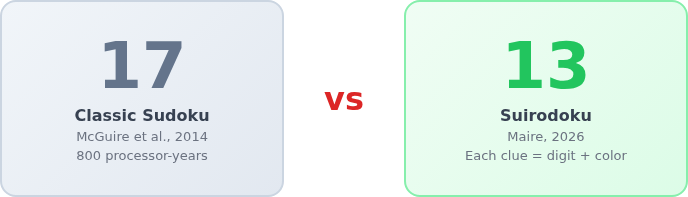
How few clues can you give someone so that they can reconstruct the entire Sudoku grid? This question was open for decades. In 2012, Gary McGuire and his team at University College Dublin finally answered it: the minimum is 17. No 16-clue Sudoku with a unique solution exists.
The proof was monumental. It required exhaustive search across billions of configurations, consuming roughly 800 processor-years of computation. The result settled one of the most famous open problems in recreational mathematics.
But what happens when each clue carries more information?
Why 13 Clues Are Enough
In Suirodoku, a clue isn't just a digit — it's a pair: a digit and a color. When you place "(5, blue)" in a cell, you simultaneously constrain both layers of the grid. The digit must fit the Sudoku rules, the color must fit the Sudoku rules, and the pair must be globally unique.
Each Suirodoku clue therefore carries roughly twice the information of a Sudoku clue. But the gain isn't exactly 2×. The orthogonality constraint (all 81 pairs unique) adds a third layer of deduction that doesn't exist in classical Sudoku. This is why the minimum drops from 17 to 13, not just to 9.
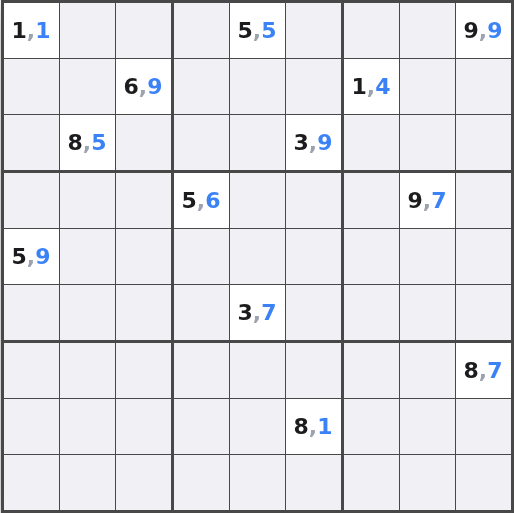
There exists a Suirodoku grid that can be uniquely reconstructed from 13 clues. This is the minimum found across all 740 orbits of the back-circulant.
The search used the CP-SAT model from Part 1: for each orbit, progressively remove clues and test uniqueness. When removing one more clue creates a second solution, you've found the minimum.
The Distribution: Most Grids Need 15–17
13 is the minimum, but it's rare. Across all 740 structural orbits of the back-circulant, here's how minimum clues are distributed:
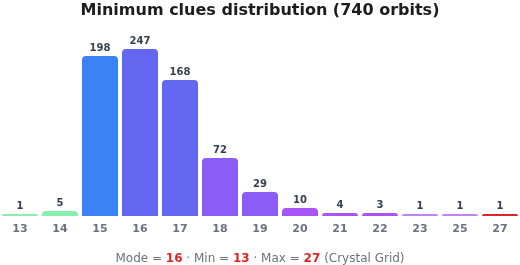
| Min clues | Orbits | Share |
|---|---|---|
| 13 | 1 | 0.1% |
| 14 | 5 | 0.7% |
| 15 | 198 | 26.8% |
| 16 | 247 | 33.4% |
| 17 | 168 | 22.7% |
| 18–27 | 121 | 16.4% |
The bulk of Suirodoku grids need 15 to 17 clues — coincidentally, 17 is exactly the Sudoku minimum. The mode sits at 16: a third of all orbits need exactly 16 clues. The tail extends to 27, where a single outlier lives — the Crystal Grid.
The Symmetry Paradox: More Symmetry = More Clues
 The Symmetry Paradox: More Symmetry = More Clues
You might expect the most symmetric grid to need the fewest clues — after all, symmetry means regularity, and regularity means predictability. The opposite is true.
The Crystal Grid — the most symmetric Suirodoku ever found (1,296 automorphisms, see Part 2) — requires 27 clues minimum. That's the maximum across all 740 orbits, and more than double the global minimum of 13.
The Crystal Grid has maximum symmetry (1,296 automorphisms) and requires the maximum number of clues (27). Symmetry makes a grid harder to pin down, not easier — because every automorphism maps one partial solution to another, creating ambiguity.
Why? Because symmetry creates equivalent configurations. If a grid has many automorphisms, removing a clue may produce multiple solutions that are all related by symmetry. You need more clues to "break" the symmetry and force a unique answer. In group-theoretic terms: the higher the stabilizer order, the more clues needed to resolve the orbit.
| Grid | Automorphisms | Min clues |
|---|---|---|
| Minimum-clue orbit | 1 | 13 |
| Typical orbit (mode) | 1–2 | 16 |
| Crystal Grid | 1,296 | 27 |
This pattern — the most symmetric object needing the most constraints to uniquely identify — is a deep structural result. It mirrors phenomena in coding theory and cryptography, where high symmetry requires longer descriptions to break.
Side-by-Side: Sudoku vs Suirodoku
 Side-by-Side: Sudoku vs Suirodoku
| Property | Classic Sudoku | Suirodoku |
|---|---|---|
| Grid size | 81 cells | 81 cells |
| Values per cell | 1 (digit) | 2 (digit + color) |
| Constraints | Row, column, block | Row, col, block × 2 + orthogonality |
| Info per clue | ~3.17 bits | ~6.34 bits |
| Minimum clues | 17 | 13 |
| Proof difficulty | 800 CPU-years | ~2 hours (CP-SAT) |
The information-theoretic lower bound for Sudoku is about 12 clues (log₂ of the solution space). For Suirodoku, the bound is similar but the structure is more constrained, so the practical minimum (13) sits closer to the theoretical floor. The extra constraints don't just reduce the minimum — they make it computationally easier to find.
What's Next
 What's Next
We've seen the numbers — 3.62 billion grids, 13 minimum clues. But among all those billions, one grid stands alone at the top: the Crystal Grid, with 1,296 symmetries, the self-dual property, and the maximum clue count. It's the mathematical crown jewel of Suirodoku.
The Crystal Grid. The only Suirodoku where digit = color on the diagonal. 1,296 automorphisms. Self-dual. The most symmetric object in the entire Suirodoku universe.
Just 13 clues. Can you solve the rest?
Play Suirodoku free.


Frequently Asked Questions
References: Maire, J. (2026). There Is a 13-Clue Suirodoku. Zenodo. DOI: 10.5281/zenodo.18820236 · McGuire, G., Tugemann, B. & Civario, G. (2014). There Is No 16-Clue Sudoku. Experimental Mathematics. · GitHub