


Top Players - Continental Rankings
Top Players - Regional Rankings
Top Players - National Rankings
A Graeco-Latin Square with Sudoku Constraints
Rainbow Technique
Each digit appears once in each of the 9 colors. Follow a digit through the grid to find the color it is still missing. The digit reveals the color.
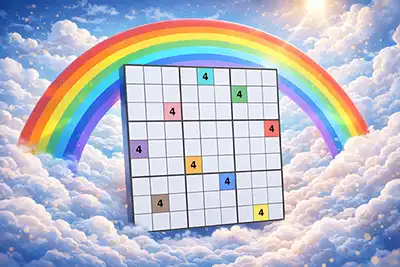 Learn more →
Chromatic Circle
Each color holds all 9 digits, once each. Follow a color through the grid to find the digit it is still missing. The color reveals the digit.
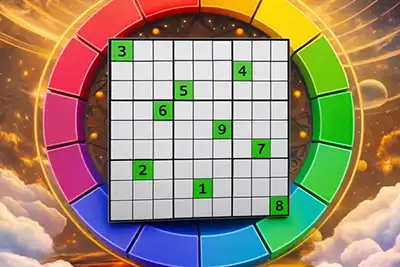 Learn more →
Tsuidoku in four minutes
Two lineages, one game.
Sudoku and Graeco-Latin squares each have their own history. Tsuidoku brings them together.
Sudoku was the warm-up.
Tsuidoku is the real game.
 What is Tsuidoku?
Tsuidoku is the first playable Graeco-Latin square with full sudoku constraints. Nine colors share the grid with the nine digits, and a fourth rule locks the two layers together, so that all 81 number-color pairs come out unique. A digit deduced anywhere constrains a color elsewhere, and the reverse. Every classic sudoku rule still holds, and a whole layer of deduction sits on top.
 The 4 Rules
The three sudoku rules apply to the digits and to the colors. The fourth links the two:
- Each row contains numbers 1-9 and all 9 colors
- Each column contains numbers 1-9 and all 9 colors
- Each 3×3 region contains numbers 1-9 and all 9 colors
- Every color contains all nine digits, and every digit shows up in all nine colors
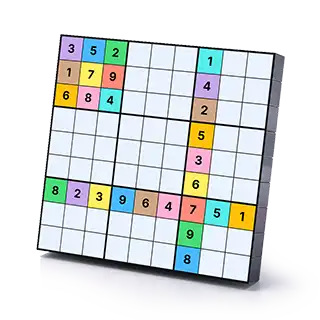
 81 Unique Pairs
The fourth rule gives each of the 81 cells a different digit-color pair. Once a pair is placed, it is gone from the rest of the grid.
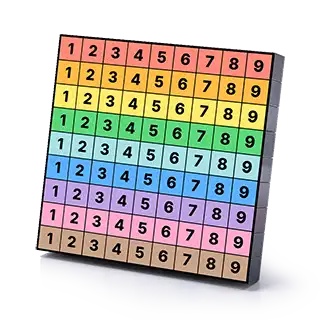
 81 cells.
 81 combinations.
 0 duplicates.
 1 solution.
Sudoku vs Tsuidoku
Sudoku
- 3 constraints
- Numbers only
- Each number repeated 9 times
- Classic techniques
Tsuidoku
- 4 constraints
- Digits and colors
- 81 unique digit-color pairs
- Classic techniques, plus 2 new mechanics
Frequently Asked Questions
What is a Graeco-Latin square?
Two Latin squares laid over each other, here one of digits and one of colors. Each row and each column holds every digit once and every color once, and each digit-color pair appears exactly once in the grid. Euler studied them in 1782.
What does Graeco-Latin orthogonality mean in Tsuidoku?
The digits and the colors are orthogonal when every digit meets every color exactly once. In Tsuidoku, this is the fourth rule. It is what makes the two new mechanics, the Rainbow Technique and the Chromatic Circle, work.
Is Tsuidoku free to play?
Yes. You can play Tsuidoku for free online in your browser. The same game is also available as Suirodoku on suirodoku.com.
How is Tsuidoku different from a Graeco-Latin square?
Tsuidoku adds the sudoku constraints: each 3×3 region must also hold the nine digits and the nine colors. Each grid has a single solution, reached by logic.